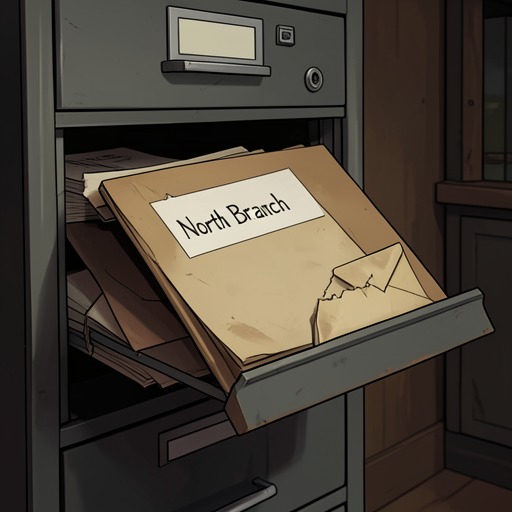
Old arrest records from the 32nd Precinct
Presumed InnocentOld arrest records from the 32nd Precinct are a group of historical booking files that Carolyn Polhemus examined during an investigation of her own. She focused on a day with an unusually large number of public-indecency arrests, but told the records clerk she had found nothing. When Rusty Sabich later examines the files, he encounters not a complete, orderly archive but a disrupted set of records, with papers missing and one numbered file unaccounted for. The files preserve both the narrow pattern Carolyn sought and the uncertainty surrounding what she made of it.
Contents and Carolyn’s Search
The records concern arrests made roughly eight or nine years earlier. Carolyn asked to see booking information for a day on which around sixty or seventy people had been arrested for public indecency. The clerk explained that she had instructed him to identify the day with the greatest number of arrests, without telling him why that date mattered. To locate it, he went through records of roughly five hundred arrests, a task he recalled taking about a week.
The arrests on the selected day shared a striking feature: the people booked were all men, and all the arrests had taken place in the Public Forest. The clerk had guessed that the arrests might have involved a demonstration, but did not know what had brought the men there. His recollection gives Rusty a specific pattern to consider, not an explanation of it. Carolyn had chosen a day by the volume of arrests, yet Rusty could find nothing in the file he had seen that explained how she had narrowed her search to that date.
After locating the material, the clerk called Carolyn back. She came to examine it and left saying that she had not found what she wanted. The account establishes the extent of her search and her reported conclusion, but does not reveal what she expected the records to show or whether the result changed her investigation. Their evidentiary significance therefore remains tied to an unanswered question: why this day, among hundreds of arrests, drew her attention.
The Files’ Condition
When Rusty returns to the records, the clerk opens a transfer case and finds loose sheets lying on top of the folders. He remembers handing Carolyn records that had been in good order. The remaining files confirm the contrast: papers have been turned around and placed at angles, and the numerical sequence has been lost. The clerk begins sorting booking sheets and bond slips by instinct; Rusty and Lionel Kenneally join him around Kenneally’s desk.
The disorder extends beyond the loose sheets. The group examines about sixty or seventy files, and none is complete. A booking jacket should contain a police report, an arrest card with the defendant’s photograph and fingerprints, a complaint, and a bond slip. Instead, papers are missing from each file. The expected structure of the records makes the damage legible: this is not simply an archive that has accumulated age or neglect, but a collection whose contents and arrangement have been disturbed.
Rusty initially considers the visible disorder alongside Carolyn’s reputation for handling other people’s carefully maintained records roughly. But after several minutes of sorting, he concludes that the papers have been shuffled deliberately. That judgment is distinct from proof of who did it or why. Kenneally and the clerk say that, since Carolyn’s visit, the boxes have remained in a corner for four months while waiting to be put back; they identify only themselves as knowing the boxes were there. Their account makes casual access less likely in Rusty’s reasoning, but it does not resolve the identity of whoever altered the records.
The Missing Number and Its Consequences
After the records have been sorted, the clerk goes through the files twice. Rusty notices that a number is missing. The clerk allows that it could be a counting mistake, particularly in a collection assembled from dozens of arrests, while Kenneally also accepts that an entire file may be gone. Neither possibility is confirmed. The missing number matters because it leaves open whether the damage consists only of displaced and incomplete paperwork or includes the removal of one booking file altogether.
Rusty asks whether a corresponding court file should still exist. The clerk’s look toward Rusty, followed by Rusty’s decision to write down the number, turns the gap in the precinct archive into a possible route for further checking. Rusty expects that the court record should be available on microfilm and notes that Dan Lipranzer will be the one to retrieve it. The records thus direct the inquiry beyond the boxes: their omissions may be tested against another institutional record, even though the scene does not establish what that comparison will show.
Significance in the Investigation
The old arrest records connect Carolyn’s earlier, unexplained research with Rusty’s later attempt to reconstruct it. Their concrete details—the selected day, the unusually high number of public-indecency arrests, the all-male group in the Public Forest, the incomplete jackets, and the absent number—give the investigation several points of reference without supplying a complete answer. The archive is useful precisely because its disorder can be described and checked, yet that same disorder limits what can be confidently recovered from it.
The files also distinguish a suspicious pattern from a settled conclusion. Carolyn’s visit establishes that she considered this cluster worth examining; her report that she found nothing does not explain her purpose. Rusty’s inference that the records were intentionally shuffled raises the possibility of interference, while the missing number remains compatible with either a mistake or a removed file. His plan to seek the court record on microfilm acknowledges that the precinct files alone cannot settle the question. The records function as an incomplete trail: they show where Carolyn looked, expose a material break in the archive, and send Rusty toward a separate source that might clarify what is missing.